
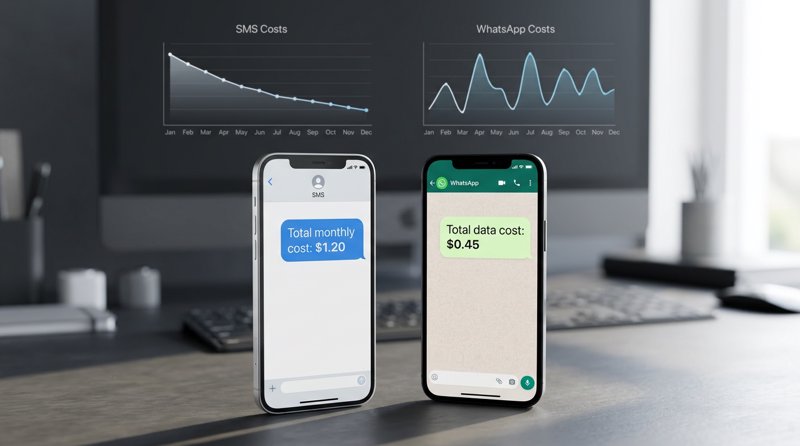
In 2026, businesses and developers face a critical decision when choosing a communication channel: SMS or WhatsApp Business API. Both offer powerful ways to engage customers, but their underlying cost structures differ significantly. This comprehensive SMS vs. WhatsApp Business cost comparison will break down the pricing models, hidden fees, and strategic implications to help you make an informed, budget-friendly choice.
The Evolving Landscape of Business Messaging Costs
Understanding the true cost of business messaging goes beyond a simple per-message rate. Various factors, including infrastructure, compliance, and regional nuances, contribute to the final bill. For many small businesses and startups, especially in developing countries, finding a balance between reach, functionality, and cost is paramount.
Traditional SMS API Pricing: The Status Quo
Traditional SMS API providers like Twilio, MessageBird, and Vonage typically operate on a per-message segment model. While this seems straightforward, the costs can quickly accumulate due to several factors:
- Per-Segment Charges: SMS messages over 160 characters (or 70 characters for Unicode) are split into multiple segments, each billed individually.
- Country-Specific Rates: Pricing varies drastically by destination country. Sending an SMS to the US might cost $0.0075, but to other regions, it could be $0.05 or more per segment.
- Sender ID/Number Costs: Dedicated long codes, toll-free numbers, or short codes incur monthly rental fees, which can range from $1/month for a long code to $1000+/month for a short code.
- Carrier Fees & Surcharges: Some carriers impose additional fees for specific message types (e.g., promotional) or regions.
- Regulatory Compliance: Navigating 10DLC registration (in the US) and other country-specific regulations adds complexity and potential costs.
For a deeper dive into alternatives to these traditional models, explore our guide on Twilio alternatives.
MySMSGate: A Revolutionary Low-Cost SMS Model
MySMSGate offers a disruptive approach to SMS API pricing by leveraging your own Android phone and SIM cards. This innovative model bypasses many of the traditional gateway markups and carrier fees, making it one of the best low cost SMS gateway comparison options available. Here's how it works:
- Ultra-Low Per-SMS Cost: MySMSGate charges a flat rate of just $0.03 per SMS. This includes all message segments and is consistent across all supported countries, as long as your SIM card supports sending to that destination.
- No Monthly Fees, No Contracts: You only pay for the messages you send. MySMSGate offers simple, pay-as-you-go packages: 100 SMS for $3, 500 SMS for $12, or 1000 SMS for $20.
- No Sender Registration: Because messages are sent from your personal SIM card, you avoid complex and costly sender registration processes like US 10DLC, saving both time and money.
- Failed SMS Refund: If a message fails to deliver, your account balance is automatically refunded, ensuring you only pay for successful transmissions.
This model is particularly advantageous for businesses in developing countries or those with highly cost-sensitive operations, offering significant savings compared to traditional providers.
Decoding WhatsApp Business API Pricing
The WhatsApp Business API, provided by Meta, operates on a fundamentally different pricing model than SMS. Instead of per-message charges, it bills based on 'conversations'. This can be both a benefit and a source of complexity.
Conversation-Based Billing Explained
A 'conversation' is a 24-hour messaging session between a business and a customer, initiated by either party. There are two main types:
- User-Initiated Conversations (Service Conversations): These begin when a customer messages your business. The 24-hour window starts with the business's first reply. The first 1,000 service conversations each month are typically free. After that, they are charged at a specific rate.
- Business-Initiated Conversations (Template Messages): These begin when your business sends the first message to a customer. These messages must use pre-approved templates (e.g., marketing, utility, authentication messages). Each new business-initiated conversation starts a 24-hour window and incurs a charge.
Within a 24-hour conversation window, all subsequent messages exchanged between the business and user are free, regardless of who sends them or how many there are. However, if the conversation extends beyond 24 hours, a new conversation fee is triggered.
Tiered Pricing and Country Variations
WhatsApp Business API pricing is highly granular, varying by:
- Country: Rates differ significantly across regions. For example, sending a business-initiated marketing message to a customer in the US will have a different cost than to a customer in India or Brazil.
- Conversation Category: Meta categorizes business-initiated templates into Marketing, Utility, and Authentication, each with its own specific rate. Service conversations (user-initiated) also have their own rate after the free tier.
As of March 2026, here are approximate US rates per conversation (after the first 1,000 free service conversations):
- Marketing Conversation: ~$0.0120
- Utility Conversation: ~$0.0060
- Authentication Conversation: ~$0.0150
- Service Conversation: ~$0.0085
These rates can be complex to predict without knowing your exact usage patterns and target geographies. Furthermore, many businesses access the WhatsApp Business API through Business Solution Providers (BSPs), who may add their own markup to Meta's underlying charges.
Direct Cost Comparison: SMS vs. WhatsApp Business API
To truly understand the difference, let's conduct a direct SMS API pricing comparison, looking at typical scenarios for small businesses and developers. We'll compare MySMSGate's flat rate with representative traditional SMS API costs and WhatsApp Business API costs.
First, a high-level table comparing key cost factors:
| Feature | MySMSGate (SMS) | Traditional SMS API (e.g., Twilio) | WhatsApp Business API |
|---|---|---|---|
| Base Message Cost | $0.03/SMS | Starts from ~$0.0075/segment (US), but varies widely by country and fees. | Conversation-based (e.g., US: ~$0.006 - $0.015 per conversation, 1000 free service/month). |
| Monthly Fees | None | Often none for basic API, but numbers/short codes have monthly fees ($1 - $1000+). | None from Meta directly, but BSPs may charge. |
| Sender ID/Number Cost | None (uses your SIM) | $1-$1000+ per month (long codes, toll-free, short codes). | None (uses your WhatsApp Business Profile). |
| Setup/Registration Cost | Free (install app, enter API key) | Potentially expensive (10DLC registration fees ~$100s, brand/campaign fees). | Free from Meta, but BSPs may charge setup fees. |
| Complexity for International | Simple (if SIM supports) | High (varying rates, regulations, sender ID requirements per country). | Medium (varying rates per country, template approvals). |
| Refund on Failure | Yes, automatic | No, usually charged for attempted send. | No, charged per conversation initiated. |
| Rich Media Support | No (text only) | No (text only) | Yes (images, videos, documents, interactive buttons). |
Now, let's consider specific use cases:
Scenario 1: Sending 1000 Transactional SMS (OTP, Alerts)
- MySMSGate: 1000 SMS @ $0.03 = $20 (using 1000 SMS package)
- Traditional SMS API (e.g., Twilio, US): 1000 SMS @ ~$0.0075/segment. If each is 1 segment: ~$7.50. Add ~$1/month for a long code. Total: ~$8.50+. (Note: This assumes minimal segments and no other fees. International or multi-segment messages would be significantly higher).
- WhatsApp Business API: If these are user-initiated 'service' conversations and within the first 1,000 free per month, it could be $0. If business-initiated 'authentication' or 'utility' conversations, and after the free tier, 1000 @ ~$0.015 (authentication) = $15.
Insight: For simple, critical transactional messages, SMS remains highly competitive, especially with MySMSGate's flat rate. WhatsApp can be free for user-initiated service messages, but business-initiated ones incur costs similar to or slightly less than MySMSGate, without the complexity of traditional SMS APIs.
Scenario 2: Sending 500 Marketing Messages
- MySMSGate: 500 SMS @ $0.03 = $12 (using 500 SMS package)
- Traditional SMS API (e.g., Twilio, US): 500 SMS @ ~$0.0075/segment (e.g., ~$3.75). Plus potentially higher carrier surcharges for marketing, and a dedicated sender ID which adds monthly costs. If using a short code, monthly fees alone could be $500+. Realistically, expect $20-$100s+ depending on setup.
- WhatsApp Business API: 500 business-initiated 'marketing' conversations @ ~$0.012 = $6. This assumes all messages are within their own 24-hour conversation window and use approved templates.
Insight: For pure marketing blast cost, WhatsApp Business API can appear cheaper per conversation for simple templates, but requires template approval and lacks the universal reach of SMS. MySMSGate offers a predictable, low-cost SMS alternative without template restrictions or setup fees, making it a strong contender for those seeking the cheapest SMS API for small business marketing.
Scenario 3: 100 Customer Service Interactions (2-way messaging)
- MySMSGate: If each interaction involves 5 messages (2 business, 3 customer replies), that's 500 SMS @ $0.03 = $12.
- Traditional SMS API (e.g., Twilio, US): 500 segments @ ~$0.0075 = ~$3.75. Plus monthly number rental. Total: ~$5+.
- WhatsApp Business API: If all 100 are user-initiated 'service' conversations and within the first 1,000 free per month, the cost is $0. If after the free tier, 100 @ ~$0.0085 = $0.85.
Insight: For customer service, WhatsApp Business API is often the most cost-effective if conversations are user-initiated and within the 24-hour window, especially with the free tier. Traditional SMS APIs can be competitive if message volume is low, but MySMSGate provides a simple, predictable alternative.
Beyond Cost: Feature & Strategic Considerations
While cost is a primary driver, it's essential to consider other factors that influence your choice between SMS and WhatsApp Business API.
Reach and Reliability
- SMS: Universal reach. Nearly every mobile phone globally can receive an SMS, regardless of internet connectivity or smartphone type. Delivery rates are generally high for critical messages like OTPs and alerts.
- WhatsApp Business API: High reach in regions where WhatsApp is dominant (e.g., India, Brazil, parts of Europe). Requires recipients to have the WhatsApp app and an active internet connection. Less effective for reaching users without smartphones or in areas with poor internet.
Rich Media and Interactivity
- SMS: Limited to text (and emojis, though these can impact segment count). No rich media, buttons, or interactive elements.
- WhatsApp Business API: Supports rich media (images, videos, documents), location sharing, and interactive elements like quick-reply buttons and call-to-action buttons. This makes it ideal for engaging, conversational experiences.
Compliance and Setup Complexity
- SMS (Traditional): Increasingly complex with regulations like 10DLC, requiring brand and campaign registration, which can be costly and time-consuming.
- SMS (MySMSGate): Significantly simpler. No sender registration, as messages are sent from your own SIM. Compliance is primarily about adhering to local spam laws for your SIM card.
- WhatsApp Business API: Requires approval of message templates, adherence to Meta's commerce and business policies, and often involves working with a Business Solution Provider (BSP) for setup, which can add complexity and cost.
Developer Experience and Integration
- SMS (MySMSGate): Extremely simple REST API with a single endpoint (
POST /api/v1/send). Easy to integrate into any application.curl -X POST https://mysmsgate.net/api/v1/send \-H "Content-Type: application/json" \-H "X-API-KEY: YOUR_API_KEY" \-d '{ "to": "+1234567890", "message": "Hello from MySMSGate!" }'For more detailed instructions, check our API documentation and integration guides.
- WhatsApp Business API: More complex setup involving webhooks, message templates, and often an SDK from a BSP. Requires more development effort for rich features.
When to Choose SMS (and How MySMSGate Excels)
SMS remains indispensable for several critical use cases, especially when cost, reliability, and universal reach are paramount:
- Cost-Sensitive Operations: For businesses with tight budgets, MySMSGate offers an unparalleled price point of just $0.03 per SMS, with no hidden fees or monthly charges. This makes it ideal for startups and small businesses.
- Global Reach, Especially Developing Markets: SMS works everywhere, regardless of internet access or smartphone penetration. This is crucial for reaching customers in regions where WhatsApp usage might be lower or data plans are expensive.
- Critical Notifications & 2FA: For time-sensitive alerts, one-time passwords (OTPs), and appointment reminders, SMS offers the highest guarantee of delivery and immediate visibility without requiring an app or internet connection. (See our guide on appointment reminder SMS without Twilio).
- Simplicity and Speed: If you need to send plain text messages quickly and reliably without complex features or template approvals, SMS is the most straightforward option.
- No Sender Registration Hassle: MySMSGate allows you to send messages through your own SIM, bypassing the costly and complex sender registration processes required by traditional SMS gateways.
If you're looking for the cheapest SMS API for small business needs, MySMSGate's model of leveraging your own Android phone makes it a standout choice for predictable and low-cost bulk SMS.
When to Opt for WhatsApp Business API
Despite its complexities and varied pricing, WhatsApp Business API shines in scenarios where rich engagement and interactive conversations are key:
- Rich Media and Interactive Experiences: For marketing campaigns that benefit from images, videos, or interactive buttons, WhatsApp offers a superior experience.
- Customer Support Conversations: The 24-hour conversation window and free user-initiated messages make WhatsApp excellent for providing real-time customer support, allowing for detailed back-and-forth without incurring per-message costs.
- High Engagement in Specific Markets: If your target audience is heavily concentrated in regions with high WhatsApp penetration and expects communication on that platform, it can be a powerful channel for engagement and brand building.
- Building Rich Customer Journeys: For complex customer flows involving multiple steps, feedback, and diverse media, WhatsApp provides the tools to create a seamless journey.
Conclusion: Making the Right Choice for Your Business
The choice between SMS and WhatsApp Business API ultimately depends on your specific use case, target audience, and budget. There's no single 'cheaper' option across the board; rather, it's about optimizing for value.
For businesses prioritizing universal reach, critical transactional messages, and predictable ultra-low costs without hidden fees or complex registration, SMS, especially through innovative providers like MySMSGate, is the clear winner. Its simplicity and cost-effectiveness make it ideal for developers and small businesses, particularly in emerging markets.
If your strategy leans towards rich, interactive customer engagement, and your audience is already on WhatsApp, the WhatsApp Business API offers powerful features, though with a more complex pricing structure and setup. Often, a hybrid approach leveraging the strengths of both platforms can be the most effective strategy.
In 2026, MySMSGate stands out as the go-to solution for businesses seeking the most economical and straightforward way to send SMS messages globally, empowering you to connect with your customers without breaking the bank.


Comments (0)
Be the first to comment!